# CapyMOA
[](https://pypi.org/project/capymoa/)[](https://coveralls.io/github/adaptive-machine-learning/CapyMOA?branch=main)[](https://discord.gg/spd2gQJGAb)[](https://github.com/adaptive-machine-learning/CapyMOA)[](https://hub.docker.com/r/tachyonic/jupyter-capymoa)
**CapyMOA does efficient machine learning for data streams in Python.** A data stream is
a sequences of items ariving one-by-one that is too large to efficiently process
non-sequentially. CapyMOA is a toolbox of methods and evaluators for: classification,
regression, clustering, anomaly detection, semi-supervised learning, online continual
learning, and drift detection for data streams.
Install with pip:
```bash
pip install capymoa
```
Refer to the [Setup](setup/index.md#setup) guide for other options, including CPU-only and dev dependencies.
```python
from capymoa.datasets import Electricity
from capymoa.classifier import HoeffdingTree
from capymoa.evaluation import prequential_evaluation
# 1. Load a streaming dataset
stream = Electricity()
# 2. Create a machine learning model
model = HoeffdingTree(stream.get_schema())
# 3. Run with test-then-train evaluation
results = prequential_evaluation(stream, model)
# 3. Success!
print(f"Accuracy: {results.accuracy():.2f}%")
```
Next, we recomend the [User Guide](tutorials.md#tutorials).
If you use CapyMOA in your research, please cite us using the following Bibtex entry:
```default
@misc{
gomes2025capymoaefficientmachinelearning,
title={{CapyMOA}: Efficient Machine Learning for Data Streams in Python},
author={Heitor Murilo Gomes and Anton Lee and Nuwan Gunasekara and Yibin Sun and Guilherme Weigert Cassales and Justin Jia Liu and Marco Heyden and Vitor Cerqueira and Maroua Bahri and Yun Sing Koh and Bernhard Pfahringer and Albert Bifet},
year={2025},
eprint={2502.07432},
archivePrefix={arXiv},
primaryClass={cs.LG},
url={https://arxiv.org/abs/2502.07432}
}
```
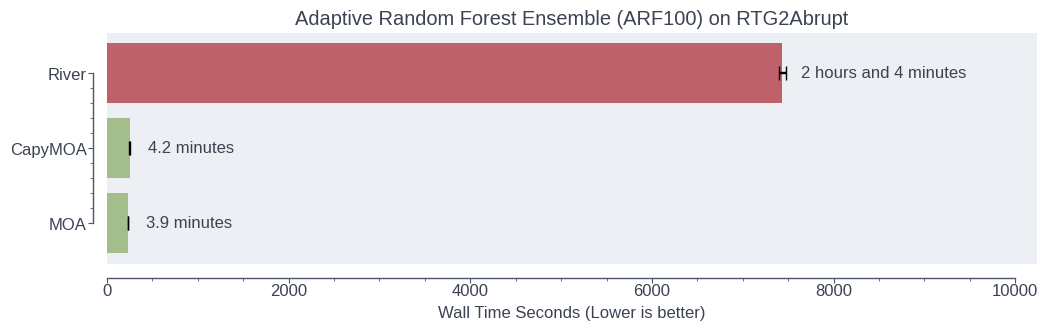
Benchmark comparing CapyMOA against other data stream libraries [1](#f1).
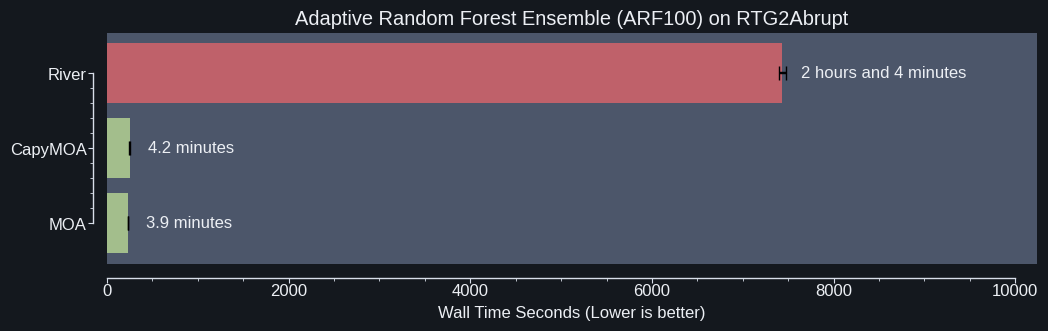
Benchmark comparing CapyMOA against other data stream libraries [1](#f1).
#### WARNING
CapyMOA is still in the early stages of development. The API is subject to
change until version 1.0.0. If you encounter any issues, please report them
on the [GitHub Issues](https://github.com/adaptive-machine-learning/CapyMOA/issues)
page or talk to us on [Discord](https://discord.gg/spd2gQJGAb).
* **[1]** Benchmark comparing CapyMOA against other data stream libraries. The benchmark was performed using an ensemble of 100 ARF learners trained on [`capymoa.datasets.RTG_2abrupt`](api/modules/capymoa.datasets.RTG_2abrupt.md#capymoa.datasets.RTG_2abrupt) dataset containing 100,000 samples and 30 features. You can find the code to reproduce this benchmark in [benchmarking.py](https://github.com/adaptive-machine-learning/CapyMOA/blob/main/benchmarks/benchmarking.py).