
Creating a new classifier in CapyMOA#
In this tutorial we show how simple it is to create a new learner in CapyMOA using Python.
We choose to make an implementation of the canonical ensemble classifier Online Bagging (AKA OzaBag).
The base learner is a CapyMOA object, which allows us to use either sklearn or MOA algorithms; so even though it will be all implemented in Python by us, it can be quite efficient in terms of run time as it depends on the base learner.
Reference: Online bagging and boosting. Oza, Nikunj C., and Stuart J. Russell. In International Workshop on Artificial Intelligence and Statistics, pp. 229-236. PMLR, 2001.
More information about CapyMOA can be found at https://www.capymoa.org.
last update on 04/12/2025
Creating the classifier#
The first step is to extend the
Classifierabstract class fromcapymoa.baseand implement the required methods:__init__(self, schema=None, random_seed=1, ...)train(self, instance)predict(self, instance)predict_proba(self, instance)
There is no need to pay much attention to the auxiliary function
poisson, even though it is a defining characteristic of Online Bagging algorithm but not that relevant for our example.We specify the parameter
base_learner_classas a class identifier and proceed to instantiate it inside the__init__method:
    self.ensemble = []
    for i in range(self.ensemble_size):
        self.ensemble.append(self.base_learner_class(schema=self.schema))
from collections import Counter

import numpy as np

from capymoa.base import Classifier
from capymoa.classifier import HoeffdingTree


# Online Bagging Implementation
class CustomOnlineBagging(Classifier):
    def __init__(
        self, schema=None, random_seed=1, ensemble_size=5, base_learner_class=None
    ):
        super().__init__(schema=schema, random_seed=random_seed)

        self.ensemble_size = ensemble_size
        self.base_learner_class = base_learner_class

        if self.base_learner_class is None:
            self.base_learner_class = HoeffdingTree

        self.ensemble = []
        for _ in range(self.ensemble_size):
            self.ensemble.append(self.base_learner_class(schema=self.schema))

    def __str__(self):
        return "CustomOnlineBagging"

    def train(self, instance):
        for i in range(self.ensemble_size):
            for _ in range(np.random.poisson(1.0)):
                self.ensemble[i].train(instance)

    def predict(self, instance):
        predictions = []
        for i in range(self.ensemble_size):
            predictions.append(self.ensemble[i].predict(instance))
        majority_vote = Counter(predictions)
        prediction = majority_vote.most_common(1)[0][0]
        return prediction

    def predict_proba(self, instance):
        probabilities = []
        for i in range(self.ensemble_size):
            classifier_proba = self.ensemble[i].predict_proba(instance)
            classifier_proba = classifier_proba / np.sum(classifier_proba)
            probabilities.append(classifier_proba)
        avg_proba = np.mean(probabilities, axis=0)
        return avg_proba
Evaluating the classifier#
We use the same approach as when we evaluate any other CapyMOA learner.
We show how it is simple to use learners with different backends in our implementation, e.g.,
HoeffdingTree(MOA)SGDClassifier(sklearn)
from capymoa.classifier import SGDClassifier
from capymoa.datasets import Electricity
from capymoa.evaluation import prequential_evaluation
from capymoa.evaluation.visualization import plot_windowed_results

elec_stream = Electricity()

# Creating a learner: using a hoeffding adaptive tree as the base learner
ob_ht = CustomOnlineBagging(
    schema=elec_stream.get_schema(), ensemble_size=5, base_learner_class=HoeffdingTree
)
ob_sgd = CustomOnlineBagging(
    schema=elec_stream.get_schema(), ensemble_size=5, base_learner_class=SGDClassifier
)

results_ob_ht = prequential_evaluation(
    stream=elec_stream, learner=ob_ht, window_size=4500
)
print(
    f"CustomOnlineBagging(HT) accuracy: {results_ob_ht.cumulative.accuracy()}, wallclock: {results_ob_ht.wallclock()}"
)
results_ob_sgd = prequential_evaluation(
    stream=elec_stream, learner=ob_ht, window_size=4500
)
print(
    f"CustomOnlineBagging(SGD) accuracy: {results_ob_sgd.cumulative.accuracy()}, wallclock: {results_ob_sgd.wallclock()}"
)

results_ob_ht.learner = "OB(HT)"
results_ob_sgd.learner = "OB(SGD)"
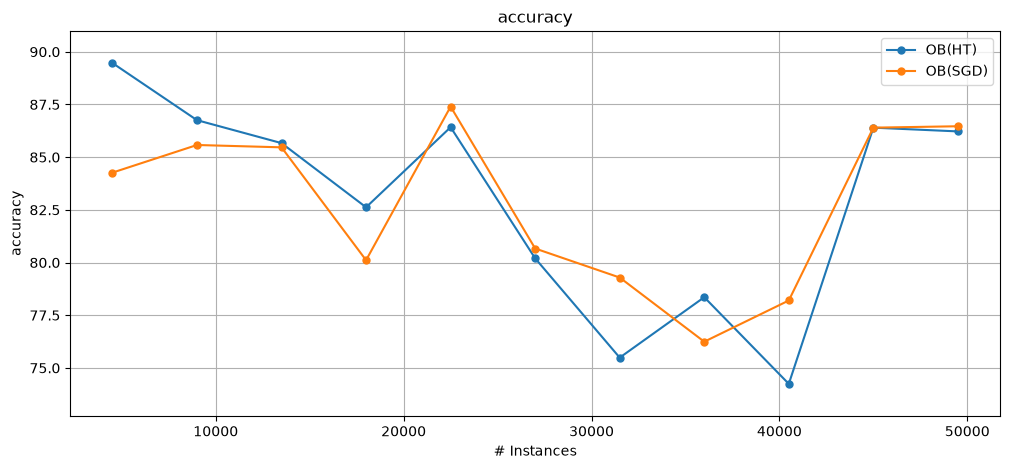
plot_windowed_results(results_ob_ht, results_ob_sgd, metric="accuracy")
CustomOnlineBagging(HT) accuracy: 82.57415254237289, wallclock: 5.563328981399536
CustomOnlineBagging(SGD) accuracy: 82.40863347457628, wallclock: 5.090241432189941
CustomOnlineBagging and OnlineBagging#
Testing and training our custom online bagging implementation alongside the online bagging implementation from
capymoa.classifier.OnlineBagging.
%%time
from capymoa.classifier import OnlineBagging
from capymoa.datasets import RBFm_100k
from capymoa.evaluation import ClassificationEvaluator

RBFm_100k_stream = RBFm_100k()

# Creating a learner without specifying the base_learner thus HoeffdingTree is used
custom_ob = CustomOnlineBagging(schema=RBFm_100k_stream.get_schema(), ensemble_size=5)
capy_ob = OnlineBagging(schema=RBFm_100k_stream.get_schema(), ensemble_size=5)

custom_ob_evaluator = ClassificationEvaluator(schema=RBFm_100k_stream.get_schema())
capy_ob_evaluator = ClassificationEvaluator(schema=RBFm_100k_stream.get_schema())

while RBFm_100k_stream.has_more_instances():
    instance = RBFm_100k_stream.next_instance()

    prediction_new = custom_ob.predict(instance)
    prediction = capy_ob.predict(instance)

    custom_ob_evaluator.update(instance.y_index, prediction_new)
    capy_ob_evaluator.update(instance.y_index, prediction)

    custom_ob.train(instance)
    capy_ob.train(instance)

print(f"[custom] Online Bagging acc: {custom_ob_evaluator.accuracy()}")
print(f"[capymoa] Online Bagging acc: {capy_ob_evaluator.accuracy()}")
[custom] Online Bagging acc: 66.556
[capymoa] Online Bagging acc: 60.357000000000006
CPU times: user 20 s, sys: 106 ms, total: 20.1 s
Wall time: 18.4 s