
TinyBlobs#
- class capymoa.anomaly.datasets.TinyBlobs[source]#
Bases:
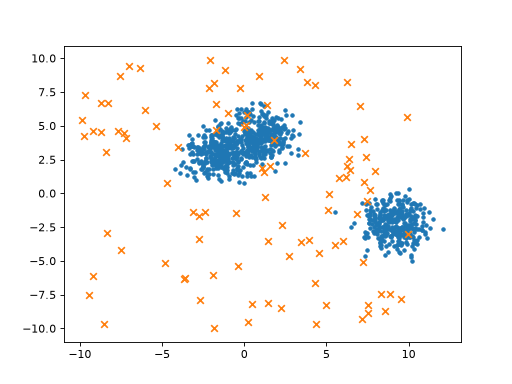
NumpyStreamA tiny stream for running unit tests for anomaly detection.
import matplotlib.pyplot as plt
from capymoa.anomaly.datasets import TinyBlobs

stream = TinyBlobs()
x, y = stream._x_data, stream._y_data
plt.scatter(x[y == 0, 0], x[y == 0, 1], marker=".")
plt.scatter(x[y == 1, 0], x[y == 1, 1], marker="x")
- __init__(
- in_samples: int = 1000,
- out_samples: int = 100,
- features: int = 4,
- clusters: int = 3,
- seed: int = 0,
- center_box: tuple[float, float] = (-10.0, 10.0),
- cluster_std: float | list[float] = 1.0,
Construct TinyBlobs.
- Parameters:
in_samples – In distribution samples.
out_samples – Out of distribution samples.
features – Number of features.
clusters – Number of clusters.
seed – Random seed for generating data.
center_box – Range features may take.
cluster_std – Variance of each blob center.
- __iter__() Self[source]#
Get an iterator over the stream.
This will NOT restart the stream if it has already been iterated over. Please use the
restart()method to restart the stream.- Yield:
An iterator over the stream.
- __next__() _AnyInstance[source]#
Get the next instance in the stream.
- Returns:
The next instance in the stream.
- next_instance() _AnyInstance[source]#
Return the next instance in the stream.
- Raises:
ValueError – If the machine learning task is neither a regression nor a classification task.
- Returns:
A labeled instances or a regression depending on the schema.